
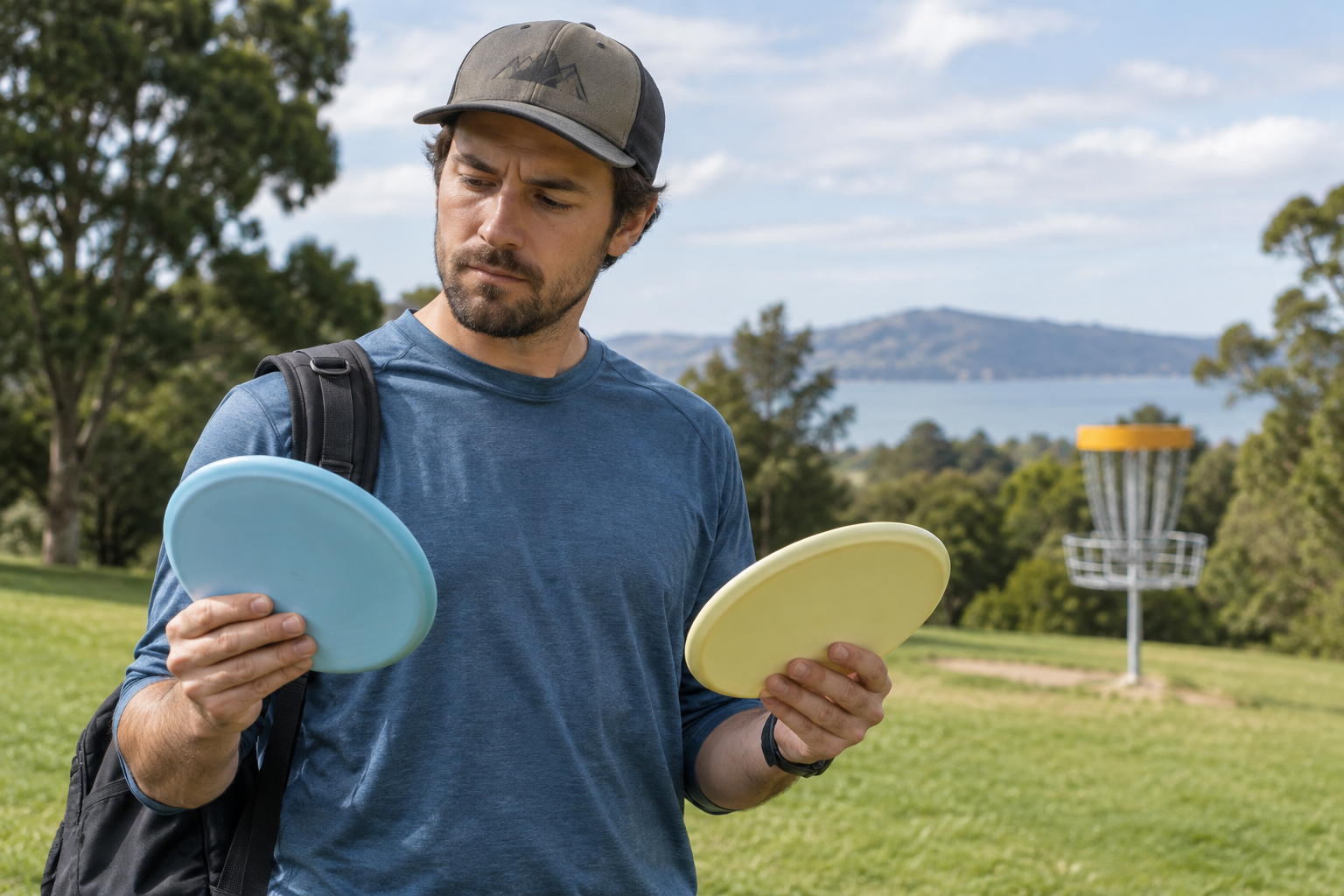
The four numbers on a disc can look like a secret code when you are choosing gear. They are best treated as a quick guide to a disc’s intended flight, not a promise that it will fly exactly the same for every player. Your release speed, angle, spin and the conditions all affect what happens in the air.
The common order is speed, glide, turn, fade. Discraft describes these as a breakdown of a disc’s characteristics, while also warning that the numbers are not perfect and that players can see different flights with the same disc. Here is a practical way to read them without getting lost in the jargon.
1. Speed: how much throw the disc asks of you
Speed is not a score for how far the disc will travel. It describes the disc’s design and the speed it generally needs to show its intended flight. Faster discs often have wider rims; they can be useful when your throw can match them, but a higher speed number does not automatically add distance.
If a fast disc consistently seems to fade out early for you, that may be a sign that a slower disc is easier to get moving as intended. For a new player, comfort and control are more useful than buying the highest number in the shop.
2. Glide: how long it tends to stay aloft
Glide describes how much a disc tends to carry through the air. A higher glide rating can help a controlled throw stay aloft, while a lower-glide disc may feel easier to range or keep on a shorter line. Neither is universally better: a long open fairway and a tight approach ask for different things.
Think of glide as a tendency, not extra power built into the disc. A nose-up throw, headwind or poor release angle can still make a high-glide disc stall or finish somewhere you did not plan.
3. Turn: the early part of the flight
Turn describes the disc’s tendency to move off its initial line during the faster, early part of flight. On many flight-number systems, turn is shown as a negative number; a more negative turn rating generally points to a greater tendency to turn when thrown with enough speed.
For a right-handed backhand throw, that early movement is commonly to the right. Other throwing styles or handedness can reverse the direction you see, so learn the idea with your own familiar throw rather than memorising a picture without its context.
4. Fade: the finish as the disc slows
Fade describes the disc’s tendency to finish as it loses speed. In the common rating convention, a larger fade number suggests a stronger finishing movement. For a right-handed backhand throw, that finish is generally to the left; the direction changes with the spin orientation of the throw.
Turn and fade work together. A disc may move one way early, then finish back the other way as it slows. The exact shape depends on the throw, so the printed pair is a clue to what to test—not a guarantee of a particular S-curve.
How to use the numbers on your own discs
- Read the sequence. If the disc uses four flight numbers, identify speed, glide, turn and fade in that order.
- Make one change at a time. Compare discs you already own, rather than changing disc, grip and release angle all at once.
- Throw in a safe, open area. Use a controlled throw and note the wind and release angle so you have context for what you saw.
- Record the result. Write down the disc, throw style, approximate effort and where it finished. Your own notes will become more useful than a number alone.
- Choose for the shot. A disc that you can control reliably is often a better choice than one whose numbers look impressive.
Flight ratings are assigned descriptions, not a substitute for throwing. Discraft specifically notes that arm speed, release angle and form can change how the same disc flies for different players. Weight, wear and wind are also useful things to keep in mind when comparing your own throws.
So, next time you check a disc’s numbers, use them to form a simple expectation: how quickly it wants to fly, how much it may carry, how it may move early, and how it may finish. Then let a few calm, repeatable throws tell you whether that expectation fits your game.
Sources: Discraft Support: What are these numbers on my disc? and PDGA: What Do the Numbers on a Disc Golf Disc Mean?.
FAQs
What do the four numbers on a disc golf disc mean?
In the common sequence they refer to speed, glide, turn and fade: design speed, tendency to carry, early-flight movement and finishing movement.
Does a higher speed number mean the disc will go farther?
No. Speed is not a distance guarantee. The disc needs a throw that can produce its intended flight, and control matters as much as the rating.
What does a negative turn number mean?
In common flight-number conventions, a more negative turn rating indicates a greater tendency to move off the initial line during the early, faster part of flight when thrown with enough speed.
What is the difference between turn and fade?
Turn describes the early part of flight; fade describes the disc’s tendency to finish as it slows. The directions you see depend on the spin orientation of your throw.
Will the same disc fly the same way for every player?
No. Discraft notes that arm speed, release angle and form can change the flight a player gets from the same disc.
How can I learn what a disc’s numbers mean for my game?
Throw it in a safe open area, change one variable at a time, and record the throw style, conditions and finish so you can compare results fairly.


