Category: Gear

Discs, bags and gear worth knowing about.

  • A Practical Wet-Weather Disc Golf Kit for Aotearoa

    A Practical Wet-Weather Disc Golf Kit for Aotearoa

    Wet-weather disc golf is easier when the kit helps you stay comfortable without turning your bag into a travelling cupboard. In Aotearoa, a forecast can change between the car park and the back nine, so the goal is simple: keep your hands, discs and footing as reliable as the conditions allow.

    NZDG’s beginner guidance keeps the essentials modest: comfortable clothing, suitable footwear and a small group of familiar discs. Rain does not change that principle; it just makes preparation more valuable. The NZDG equipment guide is a useful baseline, while the PDGA’s event guidance also highlights extra towels, an umbrella and dry clothing for wet conditions.

    Start with the layers you will actually wear

    Choose a waterproof or water-resistant outer layer that still lets your shoulders move freely. A light shell is often more useful than a heavy coat because you can throw comfortably and add warmth underneath when needed. Keep a dry mid-layer in the car or in a protected bag pocket rather than carrying every spare layer on the course.

    For trousers, prioritise movement and quick drying. If the ground is wet, long trousers can also reduce the amount of mud and grass that reaches your legs. The best choice depends on the course and the forecast; the important thing is that your clothing lets you walk, bend and throw without distraction.

    Footwear matters more than another disc

    Wet tees, slopes and leaf-covered paths reward shoes with dependable grip. NZDG recommends supportive footwear suitable for varied terrain, and that advice becomes more important when the ground is slippery. Check the sole before you leave, and do not rely on worn trainers if the course is likely to be muddy.

    Pack a dry pair of socks. They weigh very little, can make the trip home much more pleasant and are useful if a puddle is deeper than it looked. If you are walking a longer course, a small plastic or waterproof bag for wet footwear keeps the rest of your gear cleaner.

    Build a dry-disc system

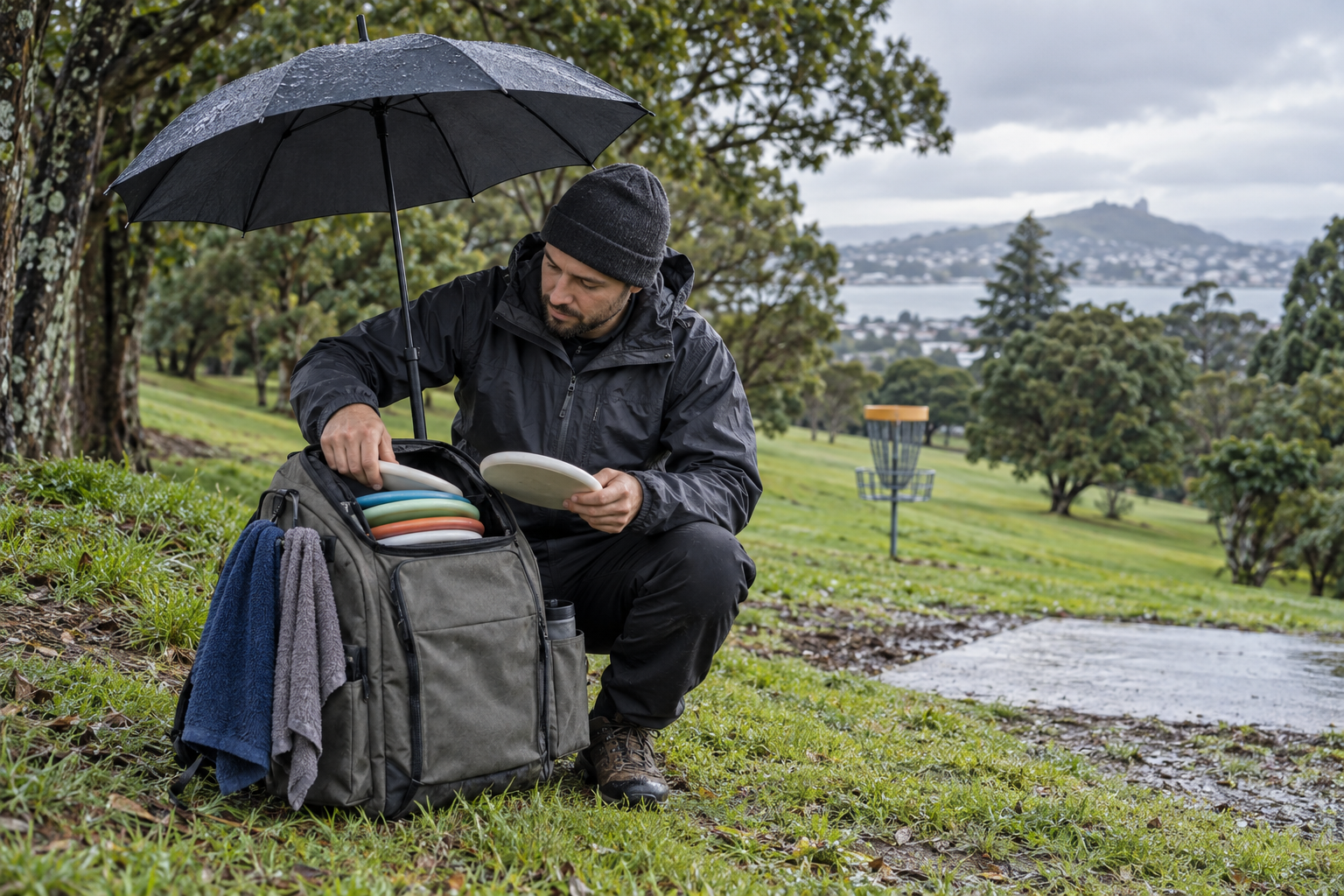
    One towel is better than none, but two or three towels with different jobs are easier to manage. Keep one towel available for the disc in your hand, one for your hands and one as a spare. Clip them where they can be reached quickly, but protect at least one from the rain until you need it.

    Use a simple routine: dry your hand, dry the rim and flight plate, choose your line, then throw without standing exposed longer than necessary. Put wet discs in a separate pocket or small bag so they do not soak the towel you are trying to keep dry. Avoid leaving discs on muddy ground when a clean towel or upturned bag is available.

    Use an umbrella or shelter strategically

    An umbrella is most useful between throws, at the tee while you are planning, or beside the bag while another player throws. It should never create a distraction or a hazard for the group. If the wind makes it awkward, a waterproof bag cover and a quick towel routine may be the better option.

    Keep your phone, keys and scorekeeping method in a genuinely waterproof pocket. A zip bag inside a normal pocket is a cheap second layer of protection, but check that you can still access what you need without exposing the rest of the bag.

    Choose a rain-friendly game plan

    Wet weather can change grip and footing, so take a little speed off throws that depend on maximum power. Prioritise a controlled run-up, a stable stance and a clean release. If the tee is slick, shorten your steps or throw from a balanced standstill rather than forcing a full run-up.

    Do not turn a gear problem into a safety problem. If there is lightning, dangerous wind, flooding or another hazard, follow the event organiser or land manager’s direction and leave the course when necessary. The PDGA competition manual makes player safety the priority when hazardous conditions make play impractical or dangerous.

    Pack the small extras

    A practical wet-weather kit can fit in a few pockets: dry socks, spare towels, a small rubbish bag, a waterproof phone pouch, hand warmers for cold days and a snack or drink for the round. Add sunscreen when the forecast is mixed; clouds do not guarantee that you will avoid sun exposure.

    After the round, dry the discs and open the bag so damp fabric can air out. Shake mud from shoes before storing them, and check towels and clothing before they develop a musty smell. Looking after the kit is part of making it ready for the next round.

    Frequently asked questions

    1. What is the most important wet-weather disc golf item?

    Reliable footwear and a way to keep your hands and discs dry are the best starting points. The right balance depends on the course, forecast and ground conditions.

    2. How many towels should I bring?

    Bring more than one if rain is likely. A separate towel for your hand, disc and spare makes it easier to keep at least one useful towel dry.

    3. Are waterproof jackets restrictive for throwing?

    Some can be, so choose a layer that allows your shoulders and arms to move freely. A light shell over a flexible mid-layer can be more practical than a heavy coat.

    4. Should I use an umbrella while throwing?

    Use an umbrella between throws or beside the bag, but keep it out of the throwing space and avoid creating a hazard or distraction for your group.

    5. What should I do if a tee pad or fairway becomes dangerous?

    Stop and reassess. Shorten your run-up, use a balanced standstill or leave the area. For organised play, follow the tournament director’s safety instructions.

    6. How should I dry my disc golf gear after a wet round?

    Dry the discs, open the bag, air out damp fabric and shake mud from footwear before storing everything. Keep wet clothing and towels separate until they are dry.
  • Disc golf flight numbers explained: speed, glide, turn and fade

    Disc golf flight numbers explained: speed, glide, turn and fade

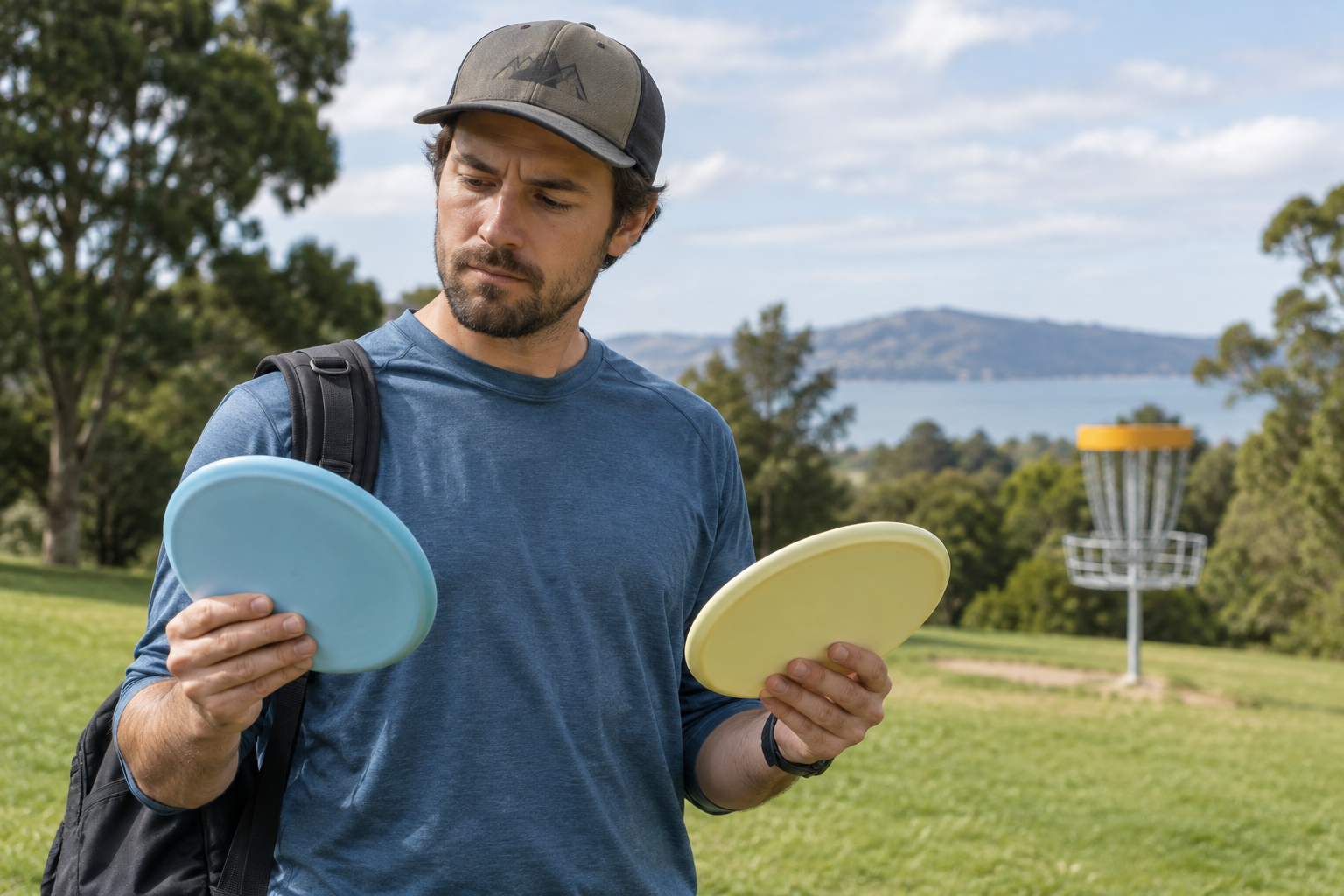
    The four numbers on a disc can look like a secret code when you are choosing gear. They are best treated as a quick guide to a disc’s intended flight, not a promise that it will fly exactly the same for every player. Your release speed, angle, spin and the conditions all affect what happens in the air.

    The common order is speed, glide, turn, fade. Discraft describes these as a breakdown of a disc’s characteristics, while also warning that the numbers are not perfect and that players can see different flights with the same disc. Here is a practical way to read them without getting lost in the jargon.

    1. Speed: how much throw the disc asks of you

    Speed is not a score for how far the disc will travel. It describes the disc’s design and the speed it generally needs to show its intended flight. Faster discs often have wider rims; they can be useful when your throw can match them, but a higher speed number does not automatically add distance.

    If a fast disc consistently seems to fade out early for you, that may be a sign that a slower disc is easier to get moving as intended. For a new player, comfort and control are more useful than buying the highest number in the shop.

    2. Glide: how long it tends to stay aloft

    Glide describes how much a disc tends to carry through the air. A higher glide rating can help a controlled throw stay aloft, while a lower-glide disc may feel easier to range or keep on a shorter line. Neither is universally better: a long open fairway and a tight approach ask for different things.

    Think of glide as a tendency, not extra power built into the disc. A nose-up throw, headwind or poor release angle can still make a high-glide disc stall or finish somewhere you did not plan.

    3. Turn: the early part of the flight

    Turn describes the disc’s tendency to move off its initial line during the faster, early part of flight. On many flight-number systems, turn is shown as a negative number; a more negative turn rating generally points to a greater tendency to turn when thrown with enough speed.

    For a right-handed backhand throw, that early movement is commonly to the right. Other throwing styles or handedness can reverse the direction you see, so learn the idea with your own familiar throw rather than memorising a picture without its context.

    4. Fade: the finish as the disc slows

    Fade describes the disc’s tendency to finish as it loses speed. In the common rating convention, a larger fade number suggests a stronger finishing movement. For a right-handed backhand throw, that finish is generally to the left; the direction changes with the spin orientation of the throw.

    Turn and fade work together. A disc may move one way early, then finish back the other way as it slows. The exact shape depends on the throw, so the printed pair is a clue to what to test—not a guarantee of a particular S-curve.

    How to use the numbers on your own discs

    1. Read the sequence. If the disc uses four flight numbers, identify speed, glide, turn and fade in that order.
    2. Make one change at a time. Compare discs you already own, rather than changing disc, grip and release angle all at once.
    3. Throw in a safe, open area. Use a controlled throw and note the wind and release angle so you have context for what you saw.
    4. Record the result. Write down the disc, throw style, approximate effort and where it finished. Your own notes will become more useful than a number alone.
    5. Choose for the shot. A disc that you can control reliably is often a better choice than one whose numbers look impressive.

    Flight ratings are assigned descriptions, not a substitute for throwing. Discraft specifically notes that arm speed, release angle and form can change how the same disc flies for different players. Weight, wear and wind are also useful things to keep in mind when comparing your own throws.

    So, next time you check a disc’s numbers, use them to form a simple expectation: how quickly it wants to fly, how much it may carry, how it may move early, and how it may finish. Then let a few calm, repeatable throws tell you whether that expectation fits your game.

    Sources: Discraft Support: What are these numbers on my disc? and PDGA: What Do the Numbers on a Disc Golf Disc Mean?.

    FAQs

    What do the four numbers on a disc golf disc mean?

    In the common sequence they refer to speed, glide, turn and fade: design speed, tendency to carry, early-flight movement and finishing movement.

    Does a higher speed number mean the disc will go farther?

    No. Speed is not a distance guarantee. The disc needs a throw that can produce its intended flight, and control matters as much as the rating.

    What does a negative turn number mean?

    In common flight-number conventions, a more negative turn rating indicates a greater tendency to move off the initial line during the early, faster part of flight when thrown with enough speed.

    What is the difference between turn and fade?

    Turn describes the early part of flight; fade describes the disc’s tendency to finish as it slows. The directions you see depend on the spin orientation of your throw.

    Will the same disc fly the same way for every player?

    No. Discraft notes that arm speed, release angle and form can change the flight a player gets from the same disc.

    How can I learn what a disc’s numbers mean for my game?

    Throw it in a safe open area, change one variable at a time, and record the throw style, conditions and finish so you can compare results fairly.

  • What a beginner disc bag really needs (and what to skip)

    What a beginner disc bag really needs (and what to skip)

    A beginner disc golf bag does not need to look like a professional player’s collection. A small set of familiar discs gives you fewer variables to manage and more chances to learn what your release, angle and speed are actually doing.

    Start with three useful jobs

    1. A putter for short throws. Use it for putting and gentle approaches. Choose one that feels comfortable in your hand and practise with it often enough to recognise a clean release.
    2. A midrange for learning flight. A controllable midrange can show you whether the disc is turning because of your angle, speed or nose position without demanding a full-power throw.
    3. A fairway disc for extra reach. Pick a fairway option you can keep on a usable line. If it only works when thrown hard, it is probably not helping you learn yet.

    These are jobs, not mandatory moulds. Borrowing discs is a sensible way to find out what feels comfortable before buying more. The right starting bag is the one you can throw, find and carry without fuss.

    Choose control before speed

    Faster discs can be useful later, but they often ask for more speed and cleaner timing. For a new player, a slower disc that flies on a predictable line is usually easier to practise with than a disc that promises distance but fades early or turns unexpectedly.

    Try a disc at the throwing speed you actually use on the course. If the disc feels difficult to keep in the fairway, step down in speed or choose a more neutral flight before adding power. Progress comes from repeatable throws, not from carrying the most advanced disc.

    Keep the bag easy to understand

    Mark or remember one job for each disc: putting, straight midrange, controlled fairway or another specific use. Avoid buying several discs that all fill the same role before you know what you want to change. A simple bag makes it easier to review a round and ask a useful question: did the throw fail, or did I choose a disc I could not control?

    Keep a towel, water and a way to record your score if they help you play comfortably. Gear that solves a real problem is more valuable than an accessory that simply adds weight.

    When to add another disc

    Add a new option when you can describe the gap it fills. You might want a more stable disc for a particular wind, a softer landing option for approaches or a spare for wet conditions. Test one change at a time so you can tell what it does.

    Do not let a new disc replace practice with the discs already in your bag. If a throw is inconsistent, changing equipment may hide the pattern rather than fix it. Learn the familiar discs first, then add deliberately.

    FAQs

    How many discs does a beginner need?

    There is no required number, but a putter, a controllable midrange and a fairway option can cover several common jobs while you learn.

    Should beginners use fast discs?

    Not necessarily. Choose discs that you can control at your current speed; a slower, predictable disc may be more useful for learning.

    Can I start with borrowed discs?

    Yes. Borrowing is a practical way to test different feels and flights before deciding what belongs in your own bag.

    What should each disc in my bag do?

    Give each disc a clear job, such as putting, straight midrange shots, controlled fairway throws or a specific approach line.

    When should I buy another disc?

    Add one when you can explain the gap it fills and test it without confusing it with several other new discs.

    What should I skip at the start?

    Skip buying several discs that all fill the same role, and avoid choosing equipment only because it is faster or marketed for more distance.